


Adwisely vs AdRoll: Which Is Better for Shopify? (2026 Comparison)
Read More

The Challenge: Manos runs a mid-size DTC supplement brand doing $50k/month in revenue. He’s spending $8,000/month across Google, Facebook, and TikTok ads. Every week, he blocks off 6 hours to juggle 47 different campaigns. He’s tweaking bids, rotating creatives, pausing underperformers, launching new audiences. By Thursday afternoon, his eyes glaze over. On Friday, his thumb slips and he accidentally wastes $400 on a broad audience targeting “people interested in wellness.” Sound familiar?
For two years, Manos accepted this as the cost of running a digital brand. Manual ad management was just part of the game. Then he discovered AI Agents for Shopify Ads—and his entire approach to advertising changed overnight.
This is the story of how AI Agents for Shopify Ads are reshaping e-commerce advertising in 2026. And why smart store owners are abandoning spreadsheets and tired automation rules in favor of intelligent systems that don’t just execute commands—they think, adapt, and optimize in real time.
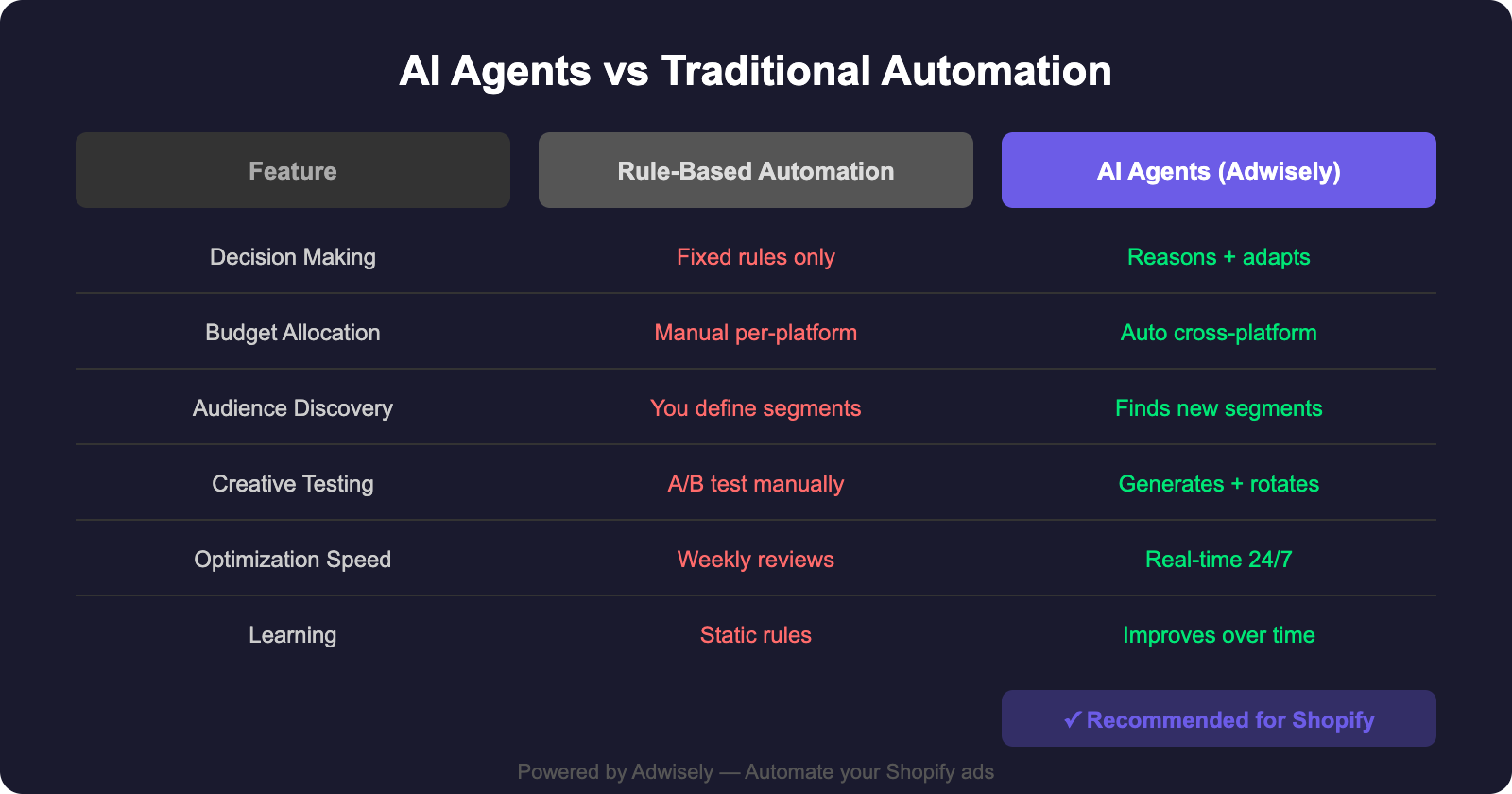
If you’ve dabbled with ad automation, you’ve likely bumped into rules-based systems: “If CPM exceeds $2, pause the campaign.” “If ROAS drops below 1.5x, reduce daily budget by 20%.”
These rules work fine when the world is predictable. But advertising is chaos. Algorithms shift. Audiences overlap. A competitor launches a flash sale. iOS privacy changes ripple through your attribution. Seasonal demand spikes overnight.
AI Agents for Shopify Ads operate differently. Instead of following a fixed decision tree, they do four things:
The key difference: rules-based automation is reactive. AI Agents for Shopify Ads are proactive. They don’t just follow instructions. They reason about your business and adjust strategy based on patterns and outcomes.
Let’s break down the core capabilities that make AI agents game-changing for e-commerce brands:
Instead of quarterly budget reviews, AI agents redistribute your ad spend daily based on performance. If Google Shopping is delivering 4.2x ROAS and Facebook is stuck at 1.9x, the system doesn’t wait for your approval—it shifts budget automatically, respecting your minimum ROAS floor. Manos’s agent recalculated his budget allocation twice a week, moving money from lagging channels to high-performers. Result: his overall ROAS climbed from 1.8x to 3.2x within the first month.
AI agents don’t just target the audiences you’ve manually defined. They analyze your Shopify customer data—purchase history, product affinity, LTV, repeat purchase rate—and automatically create high-intent segments. They identify which cohorts are most profitable and bid aggressively for them while pulling back on looser segments. For supplements, Manos’s agent discovered that customers who bought his “vegan bundle” were 3.2x more likely to repurchase within 60 days. It built a lookalike audience from that segment and scaled spend there. Waste dropped. ROI soared. This is the power of AI Agents for Shopify Ads in action.
Manual creative testing is slow. You might rotate four variations a month and declare a winner. AI agents test continuously across dozens of creative variations simultaneously, pause underperformers in hours, and scale winners immediately. Manos went from managing 4 ad creatives to running 20+ variations across his campaigns. The agent kept the top performers fresh while culling the duds in real time.
Google’s Performance Max campaigns and Meta’s Advantage+ Shopping campaigns are “black boxes”—you set a target ROAS and the algorithm optimizes. But there’s an upper limit. Most Shopify store owners leave money on the table because they don’t adjust bids granularly enough or because they’re not feeding the right signals back to the platforms. AI agents continuously adjust bids based on minute-level performance data, feed rich first-party signals (like high-LTV customer attributes), and manage bid caps intelligently to prevent overspending during low-intent moments.
The Baseline: Manos launched his supplement brand in 2022. For the first two years, he ran ads himself using best practices: he set up campaigns on Google, Facebook, and TikTok. He created audience segments. He rotated creatives. He tracked ROAS in a messy Google Sheet.
His results were decent but stagnant. ROAS hovered around 1.8x. He was profitable, but margins were thin. His main issue: he was guessing. He’d create an audience called “Fitness Enthusiasts” and bid aggressively, but he had no idea if those people actually wanted supplements. He’d launch a new creative based on a gut feeling. By Friday, he’d realize the creative was tanking but he’d already spent $600 on it.
His worst mistake: he left a cold audience campaign running too long. It was targeting “Supplement Newbies”—people interested in fitness and health but with no purchase history. The intent was to build awareness. Instead, he burned $2,400 in a month on low-intent clicks and didn’t convert a single customer. When he finally paused it, he felt sick.
The Pivot: In Q2 2024, Manos tried an AI agent for ad management. He connected his Shopify store, synced his product catalog, and fed the agent his historical customer data (purchase patterns, LTV, repeat rates). He set one constraint: no campaign should run below a 2.5x ROAS floor.
Within the first week, the AI agent did three things Manos had never done:
The Results (First 90 Days):
Most importantly, Manos regained his sanity. He wasn’t frantically tweaking bids on Thursday afternoons anymore. He checked his dashboard daily, trusted the agent, and focused on what he actually enjoyed: product development and customer experience.
Not all optimization methods are created equal. Here’s how AI agents stack up:
| Approach | Avg. ROAS Lift | Time Investment | Adaptability | Best For |
|---|---|---|---|---|
| Manual Management | Baseline (1.0x) | 6–10 hrs/week | Weekly (slow) | Solopreneurs with simple campaigns |
| Rules-Based Automation | +5–15% | 3–4 hrs/week | Rules-dependent (rigid) | Stable, predictable markets |
| Basic Automation Tools | +10–25% | 2–3 hrs/week | Template-based (limited) | Multi-channel campaigns |
| AI Agents | +50–150% | 30–60 min/week | Real-time (dynamic) | Scaling DTC, multi-platform, complex data |
Note: Results vary by industry, campaign maturity, and current spend levels. These figures reflect typical e-commerce performance.
Shopify sits at the center of your DTC business, but most advertising platforms can’t “see” your store deeply. AI agents change that by creating a feedback loop between your ad spend and your actual customer behavior.
Modern AI agents sync directly with your Shopify admin and pull:
This data feeds directly into targeting and bidding decisions. Instead of targeting “people interested in fitness,” the agent targets “people who bought Manos’s $47 vegan bundle and have an LTV of $200+.” That’s laser-focused.
Shopify’s native audience feature lets you create segments directly from your store data. AI agents don’t just use these audiences—they expand them. They take your repeat customers, find lookalike audiences across Meta and Google, and bid aggressively. For Manos, Shopify Audiences + AI became his highest-returning traffic source.
Not all customers are equal. A customer acquired for $30 who has a $300 LTV is worth dramatically more than a $30 customer with a $50 LTV. AI agents calculate expected LTV for incoming traffic (based on historical cohort data) and bid aggressively for high-LTV-trajectory customers while staying disciplined on low-intent traffic.
Instead of broad “supplement” campaigns, AI agents identify which products are most profitable and create dedicated campaigns for them. If your vegan protein is 4x more profitable than your generic multivitamin, the agent allocates budget accordingly—and tests creative angles specific to that product’s value proposition.
The market is getting crowded. AdScale, Easy Ads, Enhencer, and dozens of other tools claim to optimize Shopify ads. Here’s how to think about the landscape:
These are automation platforms—they’re excellent for handling repetitive tasks. They’ll pause underperforming campaigns, adjust bids based on rules, and manage daily budgets. But they operate within predefined frameworks. If you want different behavior, you have to reprogram the rules. They’re reactive, not proactive.
These focus narrowly on bid optimization—usually within a single platform (like Google). They’re narrow in scope but very deep. They won’t help you reallocate budget between platforms or discover new audience segments. They’re good at one thing.
Adwisely’s AI Agents for Shopify Ads takes a different approach. It’s Shopify-native, meaning it understands your store deeply. It’s multi-platform, managing Google, Meta, and TikTok simultaneously. It’s proactive—it doesn’t wait for rules to trigger; it reasons about your data and recommends (or executes) strategy. And it’s transparent—you can see exactly why it made a decision.
For Manos and other DTC brands with complex, multi-platform campaigns, true agentic AI delivers results that narrow automation tools simply can’t match.
Before handing off to an AI agent, understand your baseline. Pull your last 90 days of ad data: total spend, total revenue, ROAS by platform, top and bottom 10 campaigns by efficiency. Calculate your average CPA and your current time investment. This becomes your north star for measuring improvement.
An AI agent is only as good as its data. Connect your Shopify store, Google Ads account, Meta Business account, and any other ad platforms you’re using. Grant the agent permission to read (and eventually manage) your campaigns. The initial sync takes 24–48 hours.
Tell the agent: “My minimum ROAS is 2.5x. My total monthly budget is $8,000. Prioritize Shopify products with margins above 50%. Don’t pause campaigns without a full week of data.” These constraints guide the agent’s decision-making. Without them, it might take risks you’re not comfortable with.
The first 2–4 weeks are the learning phase. The agent is mapping your audience segments, testing creatives, and identifying high-performing budget allocations. Don’t panic if you see unusual activity (like multiple simultaneous tests). That’s learning. Check in daily, but give it room to experiment. By week 4, trends should emerge.
After the first month, the agent has a solid understanding of what works. From here, work with it to scale. If it discovered a high-performing segment, allocate more budget. If a platform is consistently underperforming, reduce spend there. Use weekly reviews to stay aligned with the agent’s strategy—not to micromanage, but to ensure it’s still tracking toward your goals.
Not all “AI agents” are created equal. Here’s a checklist to evaluate any tool you’re considering:
The e-commerce landscape is shifting, and AI Agents for Shopify Ads are at the forefront. Apple’s privacy changes, TikTok regulations, and algorithm updates are making manual ad management harder every year. Brands that rely on gut instinct and weekly tweaks will fall behind. Those who embrace AI-driven, data-first optimization will thrive.
Manos is proof. His supplement brand isn’t unique—he doesn’t have an unfair competitive advantage or proprietary products. What changed was his approach to advertising. By delegating the tactical work to an intelligent system and focusing on strategy and product, he unlocked 2.4x more ROAS and reclaimed 5+ hours of his week.
If you’re spending more than 3 hours a week managing ads, or if your ROAS has plateaued below 3x, agentic AI isn’t a luxury—it’s the competitive requirement. The question isn’t “Should I try AI agents?” It’s “How fast can I implement them?”
Below are the most common questions store owners ask about AI Agents for Shopify Ads.
Not entirely. An AI agent handles the tactical work—bid management, budget allocation, creative rotation, and real-time optimization. You (or your team) focus on strategy: which products to promote, creative direction, testing hypotheses, and analyzing insights. It’s a partnership, not a replacement. Most brands see ad managers spend less time on execution and more time on strategy, which is higher-value work.
Yes. Any good AI agent lets you pause recommendations, adjust budgets, or override decisions. You’re always in control. The agent is there to handle the routine, data-driven work and flag opportunities you might miss. But if you want to launch a campaign for a specific reason, you can do it and the agent will factor it into its future decisions.
Small improvements (5–10% ROAS lift) often appear within 2 weeks as the agent identifies quick wins like pausing very low-performing campaigns. Significant improvements (30%+ ROAS lift) typically appear after 4–8 weeks as the agent learns your audience segments and tests creative variations at scale. Timeline depends on your current spend level, campaign complexity, and how aligned your initial setup is with your business goals.
Good agents have guardrails. You set a minimum ROAS floor, and the agent won’t launch campaigns below that threshold. You set daily budget caps, and it won’t exceed them. You can also enable “approval mode” where the agent recommends actions but waits for your sign-off before executing. In practice, agents make far fewer mistakes than humans—they don’t have emotional days where they make bad decisions, and they don’t fatigue after 6 hours of work.
No, but Adwisely is the only platform built from the ground up as a Shopify-native, agentic AI for e-commerce advertising. Other tools like AdScale and Easy Ads offer automation, but they’re not true agents—they don’t reason or adapt the way Adwisely does. If you’re using Shopify and want true agentic capabilities, Adwisely is the most direct path.
If you found this guide helpful, check out these related resources for Shopify store owners:
Ready to let AI handle your Shopify ads? Try Adwisely free for 14 days — set up your first campaign in under 5 minutes.
AI Agents for Shopify Ads represent a fundamental shift in how e-commerce brands approach advertising. They’re not just faster or smarter—they fundamentally change the game by automating decision-making at scale, in real time, across every platform.
Manos’s story is becoming the norm. Store owners who embrace agentic AI are seeing 2x–3x ROAS improvements while reclaiming 5–8 hours every week. They’re testing more, learning faster, and scaling more responsibly than ever before.
If you’re ready to move beyond manual management, explore how Adwisely’s agentic AI can transform your Shopify advertising. The future of DTC advertising is agentic—and it’s here now.